
Description
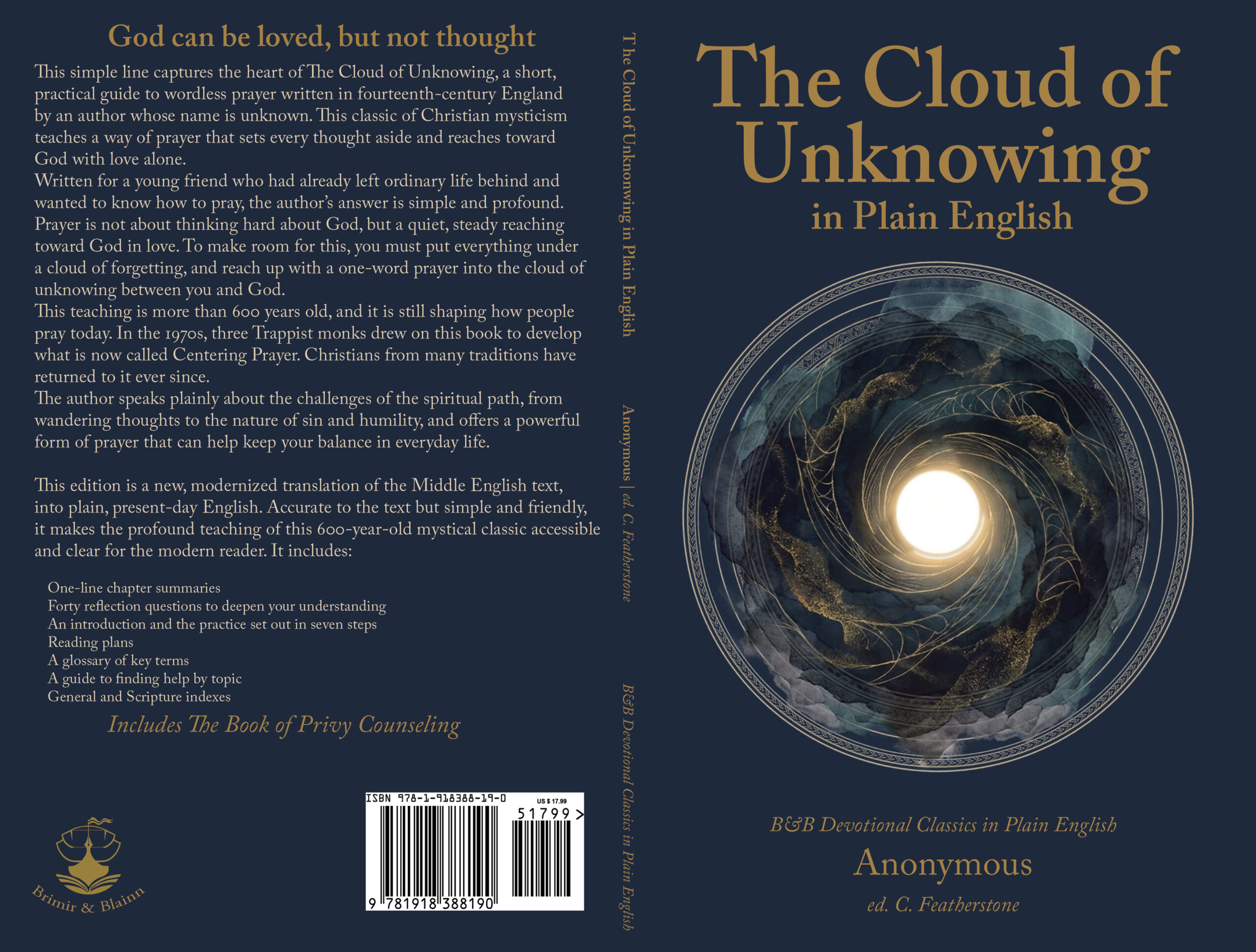
God can be loved, but not thought.
That one line sums up The Cloud of Unknowing. It is a short, practical guide to prayer, written in English in the late fourteenth century by an author whose name is not known. He wrote it for a young friend who wanted to give his life to God and asked how to pray.
The answer is simple to say and hard to do. You cannot reach God by thinking, however good or holy your thoughts are. You can reach God by love. So the author tells you to set every thought aside, even the good ones, and put them under a “cloud of forgetting.” Then, with one short word such as “God” or “love,” you reach up in love into the “cloud of unknowing” that lies between you and God. You will not see through it in this life. You keep reaching anyway.
The author is plain-spoken and often warm. He knows how prayer goes wrong. He writes about wandering thoughts, about straining too hard, about feeling nothing, and about the pride that can hide inside religious effort. He asks you to read the whole book, to take your time, and to come with a settled wish to follow Christ. He does not write for the merely curious.
Nothing certain is known about him. He wrote in the dialect of the north-east Midlands and was probably a trained cleric. He drew on older teachers of prayer, among them the writings that went under the name of Dionysius and Richard of Saint Victor. Six other works are attributed to him, among them The Book of Privy Counseling. More than six hundred years later, people still pray this way. In the 1970s three Trappist monks drew on this book to shape the practice now called Centering Prayer, and Christians from many traditions have turned to it since.
This edition puts the whole text into plain, present-day English. It is based on Evelyn Underhill’s second edition of 1922, made from British Library Harley MS 674. The author’s key terms are kept, including “cloud of unknowing” itself. Sentences are short, about 16 words on average, so the book reads clearly on the page and aloud. A one-line summary sits under every chapter heading, so you always know where you are.
The book also includes The Book of Privy Counseling, a shorter letter attributed to the same author and rendered from the Middle English of the same manuscript. It takes the teaching one step further: offer God your plain, bare being, just as you are.
The reading plans let you take the book in small daily portions. The 30-day plan covers every chapter once, with a reflection question for each day. The Advent plan gives a reading for each day of December up to Christmas Eve, and the Lent plan a reading for each of the forty days.
Inside you will find:
- an Introduction to the author, the book and its background
- The Practice in Seven Steps, the method set out simply, with seven points on The Book of Privy Counseling
- the Prologue and all 75 chapters of The Cloud of Unknowing, each with a one-line summary
- The Book of Privy Counseling in 13 sections, each with a one-line summary
- a 30-day reading plan with 30 reflection questions
- a ten-day plan for The Book of Privy Counseling with 10 reflection questions
- an Advent plan of 24 daily readings and a Lent plan of 40
- a glossary of the author’s key terms
- Where to Find Help, a guide to passages by need or topic
- a Scripture index, a general index, and a list of the other works attributed to the author
Whether you are new to contemplative prayer, already practice Centering Prayer, meet with a spiritual director, or want something to read slowly through Advent or Lent, this edition lets you read a classic of Christian prayer in the English you speak today.

Reviews
There are no reviews yet.