
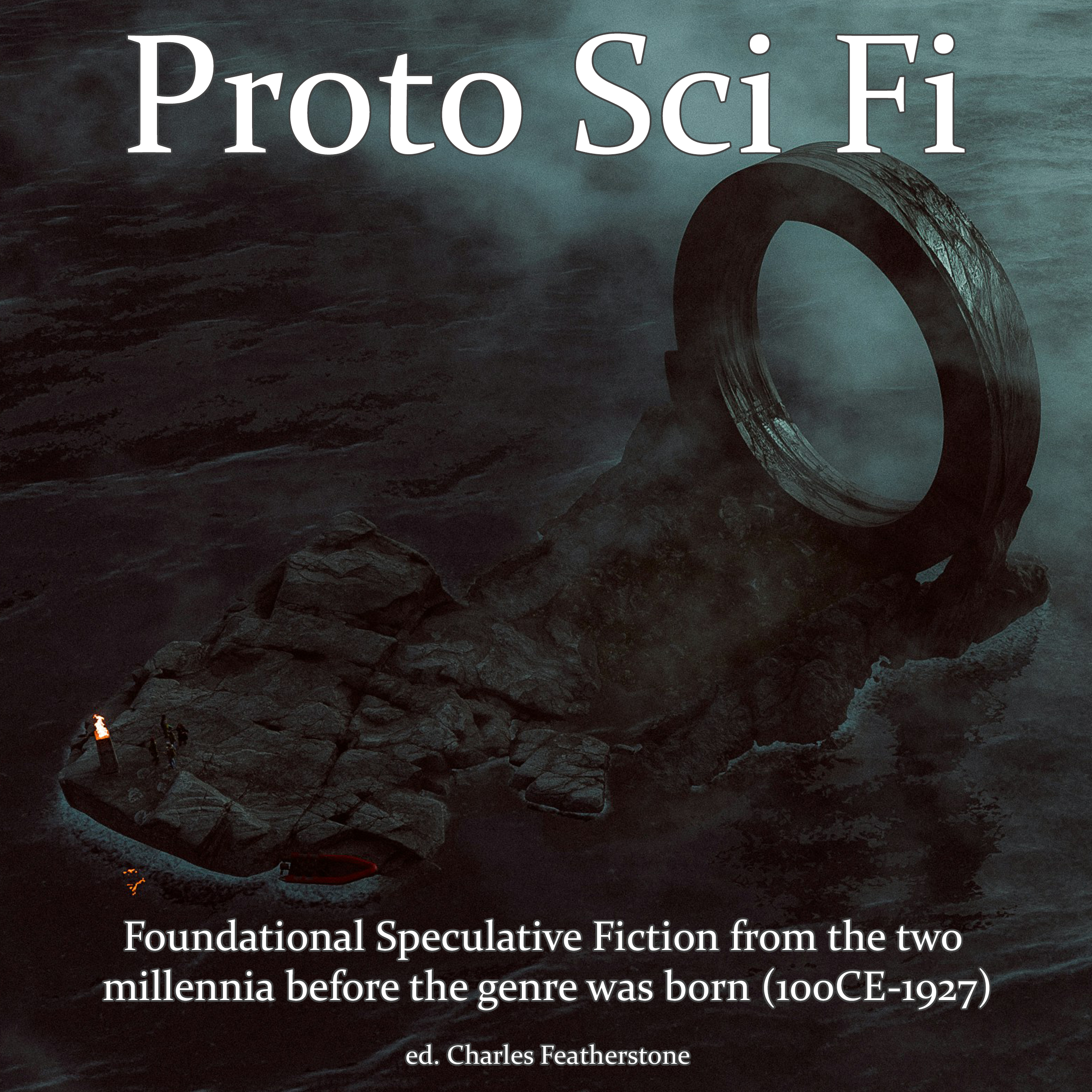
Description
Foundational Speculative Fiction from the two millennia before the genre was born (100CE-1927)
The earliest, most visionary examples of the genre in a two-thousand-year compendium of speculative fiction that begins when the height of technology was Roman concrete and the watermill, and ends on the cusp of the pulp era.
In the millennia before the term ‘science fiction’ appeared in 1851 or Hugo Gernsback popularized the term in 1929, storytellers were already gazing at the moon and wondering who might live there, and what other wonders and terrors the universe might hold. They imagined voyages to other worlds, encounters with alien intelligences, utopian futures, and experiments that pushed human knowledge too far.
Proto Sci Fi gathers the earliest, most visionary examples of the genre ina two-thousand-year compendium of speculative fiction that begins when the height of technology was Roman concrete and the watermill, and ends on the cusp of the pulp era.
This is the hidden ancestry of modern sci-fi. Collected herein are thirty-one stories, many the first of their kind, often penned by writers you know from very different contexts. Plutarch considered the science of the moon, the astronomer Johannes Kepler wrote the first hard SF, Voltaire imagined alien beings contemplating Earth with curiosity and bemusement, George Eliot tried her hand at clairvoyance and dangerous knowledge in The Lifted Veil, Edgar Allan Poe produced moon voyages, apocalypses, and visions of the far future. Even Ambrose Bierce turned his satirical pen towards killer robots, and Jack London took a trip into prehistoric discovery.
Many seminal works of fiction are included, from “the ancestor of all tales” in Japan (The Bamboo-Cutter and the Moon-Child).
Francis Bacon’s New Atlantis is a standout example of utopian fiction, Margaret Cavendish’s Blazing World was a proto-feminist work, and Cyrano de Bergerac’s moon flight has been unfairly overshadowed by his later portrayal in theatre.
The stories cover five enduring tropes. Lunar Voyages (100 CE-1869) gathers travel to the moon, taken by whirlwind ship, space stations made out of bricks, or balloons Cosmic Perspectives confronts the truly alien and the indifferent cosmos with cometary apocalypses, invisible entities, a rogue star, and a colour from the beyond. Future Histories covers visions that foretell terrible futures, or show how terrible the present is from the perspective of the far future. Other Worlds opens hidden realms in hollow earths, drops of water, and lost prehistoric plateaus. The category of Dangerous Experiments was ignited by Frankenstein, and tracks scientists going too far, from Hawthorne’s perfectionist surgeons to Bierce’s killer automaton.
From Plutarch’s discussion of philosophical theories of the moon in 100CE onwards, every story is a snapshot of its era’s cutting-edge knowledge, whether that is Copernican astronomy, Newtonian physics, mesmerism, or electrical engineering. Together, they show that while the term science fiction has only been popular for a century, speculative fiction based on science goes back as far as scientific discovery itself does.
An essential collection of 30 stories for the true sci fi enthusiast, including:
Plutarch, 100CE: The Face In The Moon
Lucian of Samosata: His True History, 182 CE; Icaromenippus, An Aerial Expedition, 165 CE
Iwaya Sazanami: The Bamboo-Cutter and the Moon-Child, 900CE
Johannes Kepler: Somnium, 1609
Francis Bacon: The New Atlantis, 1627
Francis Godwin:The Man in the Moone 1638
Cyrano De Bergerac: A Voyage To The Moon 1649
Margaret Cavendish, The Blazing World 1666
Ludvig Holberg: Niels Klim’s Journey Under The Ground, 1741
Voltaire: Micromegas, 1752; Plato’s Dream, 1756
Mary Wollstonecraft Shelley: The Mortal Immortal, 1833
Nathaniel Hawthorne: The Birthmark 1846; Rappaccini’s Daughter, 1846
Edgar Allen Poe: The Unparalleled Adventure of One Hans Pfall, 1835; Mesmeric Revelation 445, 1849; Mellonta Tauta 1849; The Facts in the Case of M. Valdemar 1845; The Conversation Of Eiros & Charmion
Fitz-James O’Brien: The Diamond Lens 1858; What Was It? A Mystery 1859
George Eliot: The Lifted Veil 1859
Ambrose Bierce: Moxon’s Master, 1893
George Chetwynd Griffith: A Corner In Lightning, 1896; A Genius for A Year, 1898
Jack London A Relic Of The Pliocene, 1901
HP Lovecraft The Colour Out Of Space, 1927
Also look out for our related early SF novels:
– The Brick Moon (1869), the first tale of an artificial satellite/space station
– The Flying Inn (1914), Chesterton’s alternate history of an England overtaken by Progressive Islam where alcohol is banned
– We (1920) The book that inspired 1984 and Brave New World (Yevgeny Zamyatin)
– The Star/In The Year 2889, a double feature of HG Wells and Jules Verne’s rarer SF tales
– Nathaniel Hawthorne’s Sci Fi, with extra tales from the American master
Audiobook store links:


Reviews
There are no reviews yet.